- Mar 30
- 3 min read
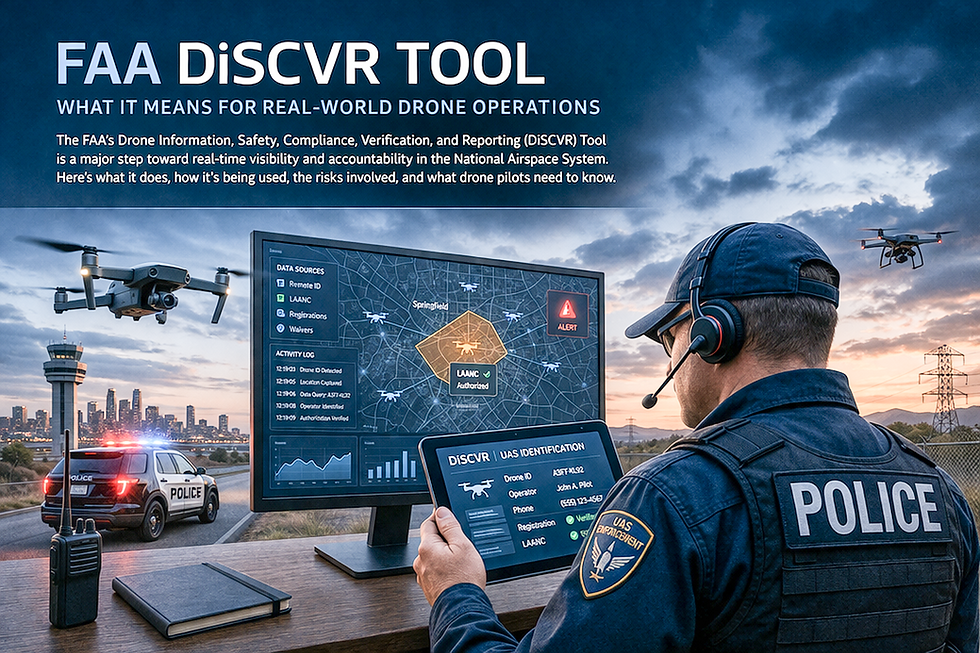
FAA DiSCVR Tool:
What It Means for your Drone Operations
The FAA’s rollout of the DiSCVR (Drone Information, Safety, Compliance, Verification, and Reporting) Tool marks a turning point in how drone operations are monitored, verified, and enforced across the National Airspace System.
This isn’t a feature update. This is infrastructure.
For those building serious UAS programs—public safety agencies, utilities, infrastructure operators, and enterprise teams—DiSCVR represents the shift from fragmented oversight to integrated, data-driven airspace awareness.
What DiSCVR Actually Does
DiSCVR connects multiple FAA systems into a single operational framework. It aggregates:
Remote ID broadcast data
LAANC authorizations
FAA DroneZone registrations
Waivers and operational approvals
This allows authorized users to answer three critical questions in real time:
Who is flying? - Where are they flying? - Are they authorized to be there?
That level of visibility has never existed at scale—until now.
How It’s Being Used in the Field
Public Safety & Law Enforcement
DiSCVR gives law enforcement the ability to identify and validate drone operations in real time.
When a drone is broadcasting Remote ID, agencies can:
Capture identifying data from the aircraft
Query the system
Verify operator identity and contact information
Confirm whether the flight is authorized
This closes one of the biggest operational gaps that has existed in drone enforcement for years.
Incident Response & Critical Infrastructure Protection
Whether it’s a wildfire, a stadium event, or an airport perimeter, DiSCVR enables:
Rapid validation of drones operating in sensitive areas
Identification of unauthorized or unsafe operations
Coordination across agencies
For organizations operating in high-risk environments, this is a critical capability.
Foundation for Scalable UAS Integration
DiSCVR is not just about enforcement—it’s about scale.
This system supports the FAA’s long-term push toward:
BVLOS operations
UAS Traffic Management (UTM)
Integration of drones into controlled airspace
It is part of the backbone required to move from isolated drone flights to routine, repeatable operations at scale.
The Risks and Realities
No system at this level comes without implications.
1. Operator Visibility is Now the Standard
Drone pilots are no longer operating in a low-visibility environment.
With Remote ID tied into DiSCVR:
Aircraft are identifiable
Operations are traceable
Compliance can be verified instantly
This is a fundamental shift in how the airspace is managed.
2. Privacy and Data Exposure
Authorized users can access operator details tied to a flight.
This introduces legitimate concerns around:
Data access and control
Information security
Potential misuse or overreach
As adoption expands, governance and safeguards will matter.
3. Enforcement Will Accelerate
Historically, enforcement has been limited by visibility.
That limitation is gone.
We should expect:
Faster response to violations
Increased enforcement actions
Less tolerance for non-compliant operations
4. Knowledge Gaps Still Exist
While the technology enables visibility, not every stakeholder fully understands drone regulations.
This creates friction:
Legal operations may still be questioned
Pilots may need to justify compliant flights in real time
Technology solves awareness—not necessarily understanding.
What Drone Operators Must Do Now
This is where the industry separates professionals from hobbyists.
Operate as if You Are Always Being Observed
Because now—you are.
Maintain Full Compliance at All Times
At minimum:
Remote ID compliant aircraft
Current registration
Proper LAANC authorization
Waivers documented and accessible
If you cannot prove compliance quickly, you are exposed.
Be Prepared for Field Interaction
Operators should be ready to:
Explain their mission clearly
Provide documentation on demand
Engage professionally with authorities
Shift from “Can I Fly?” to “Can I Defend This Operation?”
That is the new standard.
Final Thought
DiSCVR is not the future. It is the present.
And it signals a clear direction:
Drone operations are no longer experimental—they are becoming accountable, trackable, and integrated into national infrastructure.
The question is no longer whether the industry will mature. It’s whether operators are ready to meet that standard.
Learn more about DiSCVR here: FAA DiSCVR Tool | Federal Aviation Administration
Michael Hill is the Founder of Uncrewed Aerospace, an award-winning Drone Technology Company, that helps clients integrate Uncrewed Technology & Ai on the land, in the air, and at sea. Follow our work at www.uncrewedaerospace.com #TheDronePro